Originally from the Caribbean Islands, Sophie-Claire Coudoux’s poetry circles themes of spirituality, family, history, womanhood and nature within the Caribbean context.
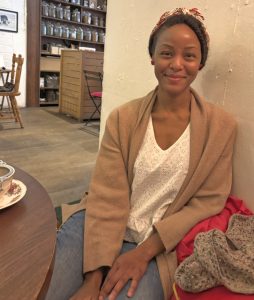
POETRY
Context for this poem: In February 1839, 53 Africans were kidnapped and sold illegally to two Spanish slave traders. On the boat (La Amistad), the African broke free and killed the captain and the cook. The event contributed to the abolitionist movement in America. This poem commemorates the leader of the slave rebellion on La Amistad, Joseph Cinqué.
Amistad, the slaves’ rebellion
The ship was not meant to hide
The people of the sun in its belly
And hold down dreams

that once flew in the hot sky of Africa.
It was not meant to coat their black skin
With a pungent salted film

And flee in disgrace through whales
Back to its country
With fragmented souls.

It was not meant to be instrumental
In the demise of free men. Now slaves,
Echoing on the walls of its prison

Screeching, piercing, agonising
Words of prayers and songs
Lost in sea and pleading

With gods and two Spanish abductors.
It was not meant to witness them wishing to sink
Their pain in the unknown of the blue

And to follow a dreary course,
Up and down, left and right, to pitch
Through raging thunder with no detour,

The ship was not meant to
Go in the opposite trajectory of hope,
To roam in the white mosses of the water

Like catatonic heartbeats
Racing, bursting under
Swollen, putrid stack of flesh,

To be a spectator of splashes of fury,
Lashes of madness cutting in flashes.
And so, something happened out there.

Darkness filled the clouds.
They were making the stones fall like rain.
The wind converged by the ocean,

Rose and formed a storm, it shouted.
The sky's anger swelled
and eyed the ship.

The white drapes shifted,
East, then west, then north,
Succeed and fell to dodge the hits.

Hotter and hotter became the sea,
Brewing an ideal outcome,
Waiting on the wind to become

A cyclone swirling in full force.
The ship glided over and under
The white blades of the waves.

A nail on the rope, an escape—
One man, then a few more
Rampaged through passages to the deck.

With their last strength,
They struck at the top of the ship
That just hung on a tired surface.

Through gunshots, fists and blows
Were thrown in sync with chaos.
No shield, just instincts of survival.

In the sky, the vultures flew low,
Mocked the appearing rainbow
And waited at the edge of the scene.

The bow of the ship veered south.
The wheels were now secured
By the hands of the escaped slaves.

The bow touched another sight
On the horizon. Maybe it was north.
They did not know.

They did not know the ship.
They did not know how to ride it.
They just did not know.
Demonising
These are the things that I saw.
A woman wrapped in white playing
with pin-ridden dolls.
Teeth out dripping cherry sunbursts
on their chin, she called in
phantoms in the middle of Saint Marie candles
Eyes disappearing behind the thick kohl.

The screen flickered,
smoking herbs swirled
nighttime occults to my psyche.
Suddenly, she was there,
worshipping Lwa,
their God, skeleton-looking
with serpents weeding its bones.

Her voice was hoarse,
cracked with sins.
Her heads swivelled like a malignant entity
following me in the greenhood of my dreams.
Hoodoo and voodoo, black witches
crafting tales of sacrifice.

I would turn my back on her shrine.
of rotten apples, revolted.
Flee to the church, hands together
in prayer, that woman was me,
I was her in their eyes until I found
A hole. I dug and I dug into the lies.

She stood amongst bird of paradise flowers,
Held the hem of her madras dress,
twirled into the hearts of men and women.
At the strike of the djembe, she relinquished
her power to them. She was something
other, something to demonise.